

Backwardation Explained: What It Means for Producers and Consumers
April 1, 2025·4 min read
Backwardation Explained: What It Means for Producers and Consumers
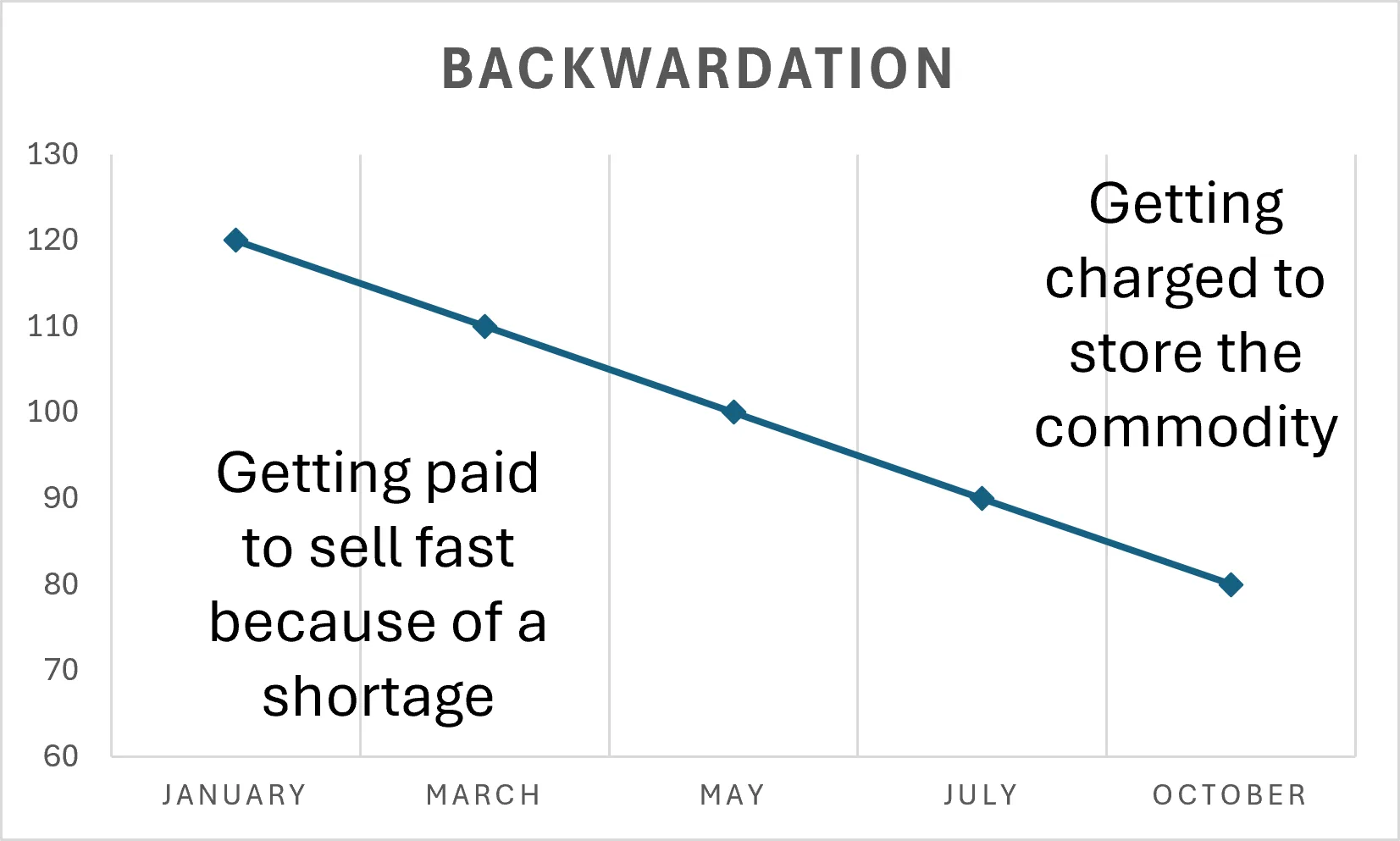
Whenever you see a future contract trading at a price that is lower than the price of a nearby contract, you are seeing backwardation. Said another way, when you see the futures curve sloping downward, you are seeing backwardation.
For example, the March oil contract is trading at $90 per barrel and the June contract is trading at $80 per barrel. This is backwardation. Why would this happen?
Let's start by saying what backwardation is not. Backwardation is not the market's expectation of lower prices in the future. It's actually the opposite. When you see backwardation, you are seeing the market's expectation of higher prices in the future. But why would that be?
That is because the market is signaling that there is a shortage of the commodity in the near term. It is paying producers to deliver sooner, it is charging for the opportunity cost of storing the commodity until a later date. How?
By delivering quickly, the producer is getting $90. By storing, the producer is not only incurring storage costs, it is also only able to hedge at a price of $80, losing $10 per barrel in opportunity cost. So the producer is better off delivering quickly. Of course, the producer could decide not to hedge at $80 and run the market risk, and hope that the shortage persists and be able to sell at a higher price later. But the futures market does its job of price discovery and helps to ensure that the market is efficient. It is up to the producer to decide whether to take that risk or not.
Change your perspective about backwardation. The futures market is not in the business of predicting the future. It is in the business of discounting all information that is available today and converting that into a price that communicates the current state of things. It is in the business of price discovery, not price prediction.
What should a consumer do with a market in backwardation?
Hedge a portion of the risk exposure to protect against price increases. Use derivatives to hedge medium to long-term exposure. Negotiate with provider a take or pay contract to lock in a price for the short term. Why?
You'll notice that during backwardation, as contracts expire and new contracts take the place of 'front month', the very day that the roll occurs there is a gap down that quickly corrects and pushes the price of the new front month to align with the spot market. Playing this roll can be a money making machine for a segment of the market, but it is risky business for a bonafide consumer hedger. But, if you lock in futures prices now, you are implicitly participating in the future string of beneficial rolls that will occur as your hedges become front month contracts.
If you hedge, you are also at risk of leaving money on the table if market conditions change and the price moves down, reflecting a new reality. That is why having a risk management strategy that is aligned to your risk profile and risk tolerance is very important.
What should a producer do with a market in backwardation?
I'll cut to the chase. Very few producer are going to pull the trigger and sell futures at a price lower than spot. We just said that a market in backwardation is bullish and a producer will want to participate to the upside. Knowledge of the derivatives market instruments helps make the right decision: a producer might choose to do a 3-way collar, for example, by selling an out of the money call, buying a near the money put, and selling a lower put. This instrument fits perfectly with the view: limited downside and potential upside. A producer could choose to leverage the sold call by making the put spread very narrow, thus being able to do two or more put spreads for every sold call.
Gosh, I love this 3-way strategy for producers.
Reach out if you want to talk about producer or consumer hedges during backwardation.
In the meantime, if you want to learn about the opposite of backwardation, check out this post: Contango Explained